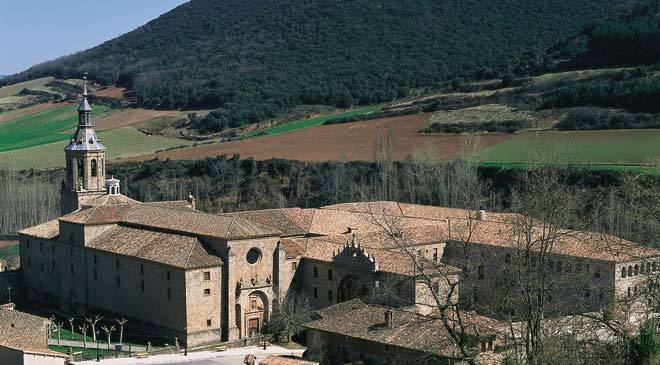
The twin monasteries of Yuso and Suso are located in San Millan de la Cogolla (La Rioja), less than ten kilometres from the town of Najera on the Camino Frances. They are known as the cradle of the Castilian language, as it was here that the first written evidence of this language was recorded.
Best visited as a 2-day detour from Najera, visitors will enjoy a walk through vineyards to San Millan de la Cogolla. This tiny settlement is dominated and defined by its world-famous UNESCO World Heritage Site of the twin monastic complex.
Join us as we look into the story of these amazing monasteries. And if you’re ready to visit this wonderful site for yourself, why not do so on our Gourmet Camino La Rioja? It’s a tour that showcases some of Spain’s most beautiful natural landscapes and dives into the nation’s first-class food culture!

The Historical Background
The story of these monasteries begins in the 6th century with the foundation of Suso by Saint Emilian, or San Millán, as he is known in Spanish. Built on the hermitage’s site where the saint himself lived, Suso offers a tangible connection to the dawn of Christianity in the region. It’s here, in the quietude of Suso, that the earliest written phrases in Spanish and Basque were etched onto the margins of a Latin text, marking the very origins of them as written languages. This linguistic milestone, coupled with the monastery’s association with Gonzalo de Berceo, the first Spanish poet known by name, underlines its pivotal role in the evolution of Spanish literary tradition.
As the centuries passed, the monastic life within these sacred walls transitioned from hermitic isolation to a cenobitic community under the Benedictine order at Yuso. This evolution reflects a broader narrative of monasticism’s ability to adapt through the upheavals of Spain’s chaotic history.
Architectural Marvels
Perched above, Suso Monastery greets visitors with its unique blend of Visigothic, Mozarabic, and Romanesque styles. The hermits’ caves, integral to the monastery’s origins, offer a rare glimpse into the eremitic life of its early inhabitants. Meanwhile, the scriptorium stands as a testament to the monastery’s intellectual pursuits, notably the creation of the San Millán Beatus manuscript.
Down below, Yuso Monastery gives visitors an unparalleled display of Renaissance and Baroque splendor. Its construction in the early 16th century signified not just a physical expansion but a flourishing of the monastic community’s spiritual and cultural endeavors. The cloisters, library, and sacristy of Yuso are especially remarkable, housing treasures of religious art and literature.

The Birthplace of the Spanish Language
The linguistic heritage of the San Millán Monasteries is perhaps their most extraordinary legacy. The Glosas Emilianenses, annotations in early Spanish and Basque found in a Latin manuscript at Suso, are celebrated as the first written records of these languages. This linguistic breakthrough underscores the site’s significance in the annals of human culture and history.
The Suso and Yuso Monasteries’ Living Legacy
Despite the secular challenges over the centuries, including the Ecclesiastical Confiscations of Mendizábal which left Suso uninhabited, the monastic spirit endures, particularly at Yuso, which houses an Augustinian community today.
Yuso’s development, incorporating a hotel within its premises, speaks to a modern engagement with its spiritual and cultural heritage, offering visitors a unique opportunity to experience its history firsthand.
A Pilgrimage Beyond Time
The San Millán Monasteries remain centers of faith, culture, and education to this day. Their inclusion on the Way of St. James pilgrimage route, albeit slightly off the main path, attests to their enduring spiritual appeal. For those who tread this sacred ground, the journey offers a profound connection to Spanish history, language, and religious tradition.
If you’d like to undertake a once-in-a-lifetime pilgrimage in Spain, explore our Pilgrimage Routes in Spain.