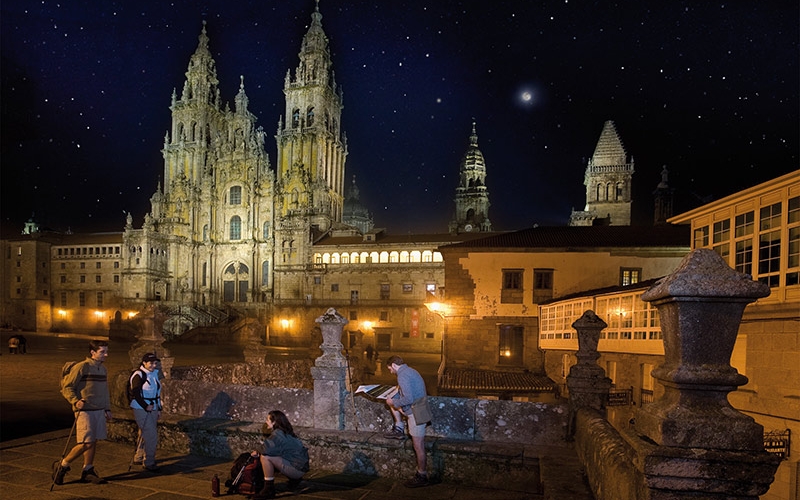
The Origins of Santiago de Compostela: A Story of Stars and Sacred Discovery
Around 813 AD, a hermit named Pelagio experienced a miraculous vision. One night, he witnessed a dazzling shower of stars illuminating the sky above a mountain we now know as Pico Sacro, or the Sacred Peak. These celestial lights seemed to cascade over a secluded field near the forest of Libredón, creating a scene so extraordinary that Pelagio reported it to the Bishop of Iria Flavia—modern-day Padrón, a key town on the Camino Portugués.
Intrigued and inspired, the Bishop gathered an entourage and set out to investigate the site. When they arrived, their search uncovered remarkable findings: the ruins of an ancient structure, an altar, and three stone tombs. Among these, one tomb stood out due to its grandeur and was identified as the final resting place of the Apostle Santiago (Saint James the Greater), one of Christ’s closest disciples and the future patron saint of Spain.
This discovery sent shockwaves through the Christian world. News quickly reached King Alfonso II of Asturias, who is said to have made a historic pilgrimage to the site, becoming the first known pilgrim to venerate the Apostle’s shrine. Deeply moved by the sacredness of the place, King Alfonso II ordered the construction of a small chapel over the Apostle’s tomb.
This humble chapel became the foundation of something much greater. Over time, the site evolved into the Cathedral of Santiago de Compostela, one of the most iconic landmarks in Christian Europe. The area was given the Latin name Campus Stellae, meaning “Field of Stars,” to honor the celestial vision that led to its discovery. Over the centuries, Campus Stellae evolved into “Compostela,” lending its name to both the cathedral and the city that grew around it.
The tale of Pelagio’s vision and the establishment of Santiago de Compostela continues to resonate with modern pilgrims. The imagery of the stars holds profound significance along the Camino de Santiago, symbolizing otherworldy guidance and spiritual enlightenment. Many pilgrims draw parallels between their own journeys and following a celestial trail, much like Pelagio who pursued the stars to reach a sacred site.
Pico Sacro’s Role: The mountain associated with the vision, Pico Sacro, was already steeped in mystery and legend long before this event. It was considered a sacred place in pre-Christian times and has been linked to ancient Galician traditions, adding layers of historical and spiritual significance to the story.
The Cathedral’s Evolution: The modest chapel constructed by King Alfonso II was just the beginning. As the number of pilgrims grew and Santiago de Compostela gained prominence as a major pilgrimage site, the chapel was expanded into a larger church. By the 11th century, construction of the grand Romanesque cathedral began, solidifying the city’s importance as the endpoint of the Camino de Santiago and a key religious center in Europe.
The sight of stars illuminating Pico Sacro, along with the discovery of the Apostle’s tomb, not only sparked the creation of Santiago de Compostela but also established the spiritual and cultural foundation of the Camino de Santiago. Today, millions of pilgrims follow in the footsteps of King Alfonso II, embarking on a journey to this sacred city in search of renewal and a connection with other travellers.
If you are planning on completing the Camino de Santiago or even part of the journey, why not take one of our Camino Walking Holidays? If you have any questions about our Camino options, please get in touch.